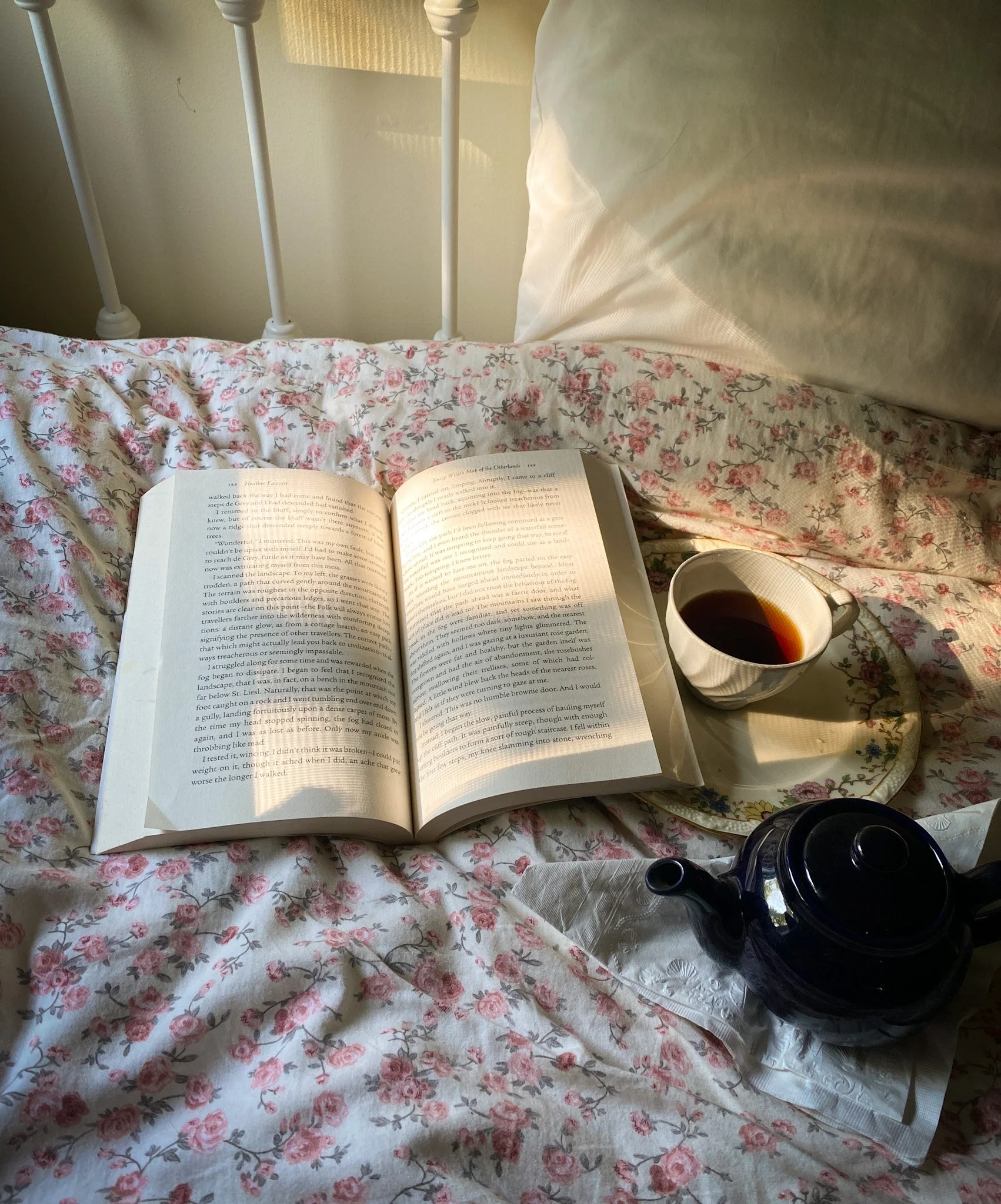
Lately I’ve been noticing something about myself that feels both familiar and unsettling, and a little hard to admit: I don’t read as much as I used to. I used to be a big reader. The kind of reader who could disappear into a book for hours, who felt nourished and expanded by sustained attention of a story or the integration of new information. And now? Well… I still read. But more often than not, a few sentences in, I notice my fingers twitching toward email . Or pulled back toward some other task that always seems to involve a screen. When did that happen? When did I start finding reasons to check email instead of turning the page? It feels like a real loss, of something important, and something I fear sometimes I won’t get back. Everyday, I’m being wired more strongly into the digital systems, every day the pull of the device, of the constant communication, networking, is ever expanding.
It’s not just my reading habits that have changed. I’m embarrassed to admit that sometimes when I’m listening to a friend or neighbor speak, I’m only half-listening, while some part of my mind scans for the next hit of stimulation. Sometimes I catch myself and think, Who is this person? Am I a human or a perpetually and mildly dissociated TikTok zombie?
And when did it get so hard to stay with one thing?
I don’t think this is a personal failure. In fact, I resist thinking about this whole thing as failure, personally or collectively. Judging and shaming doesn’t help. The fact is we’re living in an era that fragments attention by design. Infinite information, infinite opportunities, infinite ways to distract ourselves from discomfort, boredom, or longing.
What makes this especially poignant for me is that my work depends on the opposite state entirely.
When I’m with a client—whether in coaching, hypnotherapy, or group work—my phone is on Do Not Disturb. My attention is undivided. I’m listening with my whole body. I’m tracking words and pauses, tone and breath, shifts in posture and emotion. I’m noticing my own internal responses while staying attuned to theirs.
This is what co-regulation actually looks like: body to body, nervous system to nervous system, moment by moment. It requires full presence. And it’s something no app, no algorithm, and no chatbot can replicate.
I’m so grateful to be able to practice the art of attunement as my professional work.
There’s something deeply restorative about this kind of attention—not just for the client, but for me too. It reminds me what focus feels like when it’s relational rather than extractive. When it’s grounded rather than hijacked.
Hypnosis, in particular, is a fascinating counterpoint to our distracted lives. Despite all the myths, hypnosis isn’t about zoning out—it’s about a specific quality of attention. A state of sustained inward focus, where the conscious mind may wander, but the deeper listening continues. The nervous system softens. The unconscious begins to respond. It’s one of the few places where attention is allowed to turn inward without pressure or performance.
As we move into the darkest part of the year, I’ve been reflecting deeply on what it means to stay regulated and emotionally steady in a world that constantly pulls at our attention and our nervous systems. Winter asks a lot of us under normal circumstances—but in this era of overstimulation, the inner work of staying balanced has become more challenging than ever.
Recently, I wrote a piece on my other blog about my struggles with attention and my pull toward the simpler rituals of winter as regulation. What surprised me was how quickly that reflection was met with a collective “me too.” Suddenly, conversations were everywhere—about addiction, overwhelm, the loss of focus, and the exhaustion that comes from trying to manage too much input for too long.
Not long after that reflection, I had one of those synchronicity moments, when something arrives at just the right time and seems to speak directly to what you’ve been circling. That very same week I wrote the blog piece, I happened to hear to an episode of the podcast Hidden Brain titled “The Paradox of Pleasure,” and as I listened, I remember thinking, Oh. This is for me. You know that feeling—when a piece of insight lands with the precision of a well-timed mirror? Like the way a good tarot card pull can sometimes “call you out” by calling you back to yourself. This felt like that. A wake-up call. A call to attention.
The episode explores what neuroscientists call the pain–pleasure seesaw. In simple terms, every time we engage with something highly stimulating or rewarding—scrolling, shopping, notifications, caffeine, sugar, endless content—the brain compensates with a counterweight of discomfort. Pleasure spikes dopamine; the nervous system restores balance by tipping us toward the other side of the seesaw. In earlier eras, this cycle moved slowly and naturally. Today, with constant access to dopamine-producing stimulation, the swings are sharper and more frequent. The psychologist on the show described this as the “drugification” of modern life. That phrase stayed with me. And, honestly, it unsettled me.
What struck me most was how accurately this framework described the states that arise on the downswing—what happens when the stimulation fades and we experience a subtle form of withdrawal. The sadness, irritability, anxiety, low mood, distraction or flatness that creeps in after (or even during) a binge or a doomscroll. I recognized the description, but I never thought of it as withdrawal before. It’s a state many of us live inside without recognizing it for what it is, because we don’t think of ourselves as dependent on stimulation. Instead, it shows up as low-grade anxiety, mental fog, restlessness, or a vague sense of dissatisfaction.
We often interpret these feelings as personal failures—something is wrong with me—when in fact they’re deeply physiological. A nervous system working overtime to recalibrate in an environment that rarely, if ever, truly powers down.
Listening to this episode of Hidden Brain, I felt both called out and oddly relieved. Called out because it named patterns I recognize in myself. Relieved because it reframed them—not as flaws of character or willpower, but as adaptive responses in a world that asks far too much of our attention.
From a therapeutic perspective, this lines up beautifully with what we see in Ericksonian hypnosis and NLP (Neuro-Linguistic Programming): the unconscious mind is always trying to restore equilibrium, often with strategies that are automatic, fast, and outside our conscious control. Whether it’s clicking an app, pouring a drink, doomscrolling, dissociating, or reaching for a cookie—we’re trying to regulate. We’re trying to feel different right now.
And from an Internal Family Systems (IFS) lens, these behaviors aren’t “bad habits” or moral failings. They’re parts doing what they learned long ago to help us cope—managers, firefighters, protectors trying to soothe our overstimulated systems the only way they know how.
When you combine:
decreased daylight
disrupted sleep
holiday stress
holiday sugar and alcohol
resurfacing family dynamics
Loneliness and isolation in winter
Complex and ambiguous grief
sensory overload
and the dopamine rollercoaster of modern life
…it becomes completely understandable why this time of year feels heavy or dysregulated for so many.
One of the most hopeful things I’ve learned in my work is how powerful the combination of hypnosis + IFS can be in moments like this. Hypnosis helps soften the trance of overstimulation and bring the nervous system into a gentler, more receptive state. IFS helps us approach the reactive or overwhelmed parts of ourselves with compassion, curiosity, and clarity. Together, they create a space where change feels like relief.
Where regulation becomes possible again.
Where coping becomes choice rather than compulsion.
Where the inner world begins to make sense.
That has been on my mind as I think about how to support people this winter—how to create offerings that feel nourishing, accessible, and stabilizing in a season that can be emotionally complicated for many.
All of this has had me thinking about how we can create small sanctuaries of regulation and connection—places where the nervous system can downshift, where our parts can feel seen and supported, where we remember that healing doesn’t have to be dramatic to be real. Sometimes it’s the simplest, most consistent practices that give us back a sense of steadiness.
With that in mind, I’ve shaped several offerings for the winter season, each designed to meet you where you are, and to give you practical, compassionate support as we move through these darker months.